
Hybrid & 3D Freeform Design: Aesthetic Innovation
Description
In the modern building materials market, the aesthetic demands of architects and developers are evolving rapidly. From the sweeping curves of advanced bullnose geometries to the expansive surfaces of large-format tiles, the "standard" geometries of the past are being replaced by complex, organic forms. Hybrid and 3D Freeform Design is the specialized WELSCH capability that allows you to lead these market trends without sacrificing mechanical stability or production speed.
Traditional CAD design is often limited by parametric rigidity, the difficulty of modeling complex, non-mathematical surfaces. WELSCH utilizes Hybrid Modeling to eliminate these constraints:
The Surgical Fusion: We link classic mechanical design techniques (for the interfaces, drives, and mounting points) with 3D Freeform Modeling (for the visible, aesthetic surfaces). This ensures that a tile can look like a handcrafted slate or a modern wave while still fitting perfectly into your high-speed pallet transport system.
Flow-Dynamic Optimization: A beautiful tile is useless if it causes slurry caking or uneven drying. Our hybrid models are analyzed to ensure that the "Freeform" geometry supports optimal material flow during the extrusion process, maintaining your 150 TPM targets.
We provide the "Visual Intelligence" required to make informed commercial decisions before a single mold is manufactured:
Photorealistic 3D Visualization: We create high-fidelity renderings that allow your marketing and sales teams to evaluate new product designs against market trends.
Movement Animation: We simulate how these new geometries interact with your machine's cutting and handling systems, identifying potential "snag points" in the 3D environment.
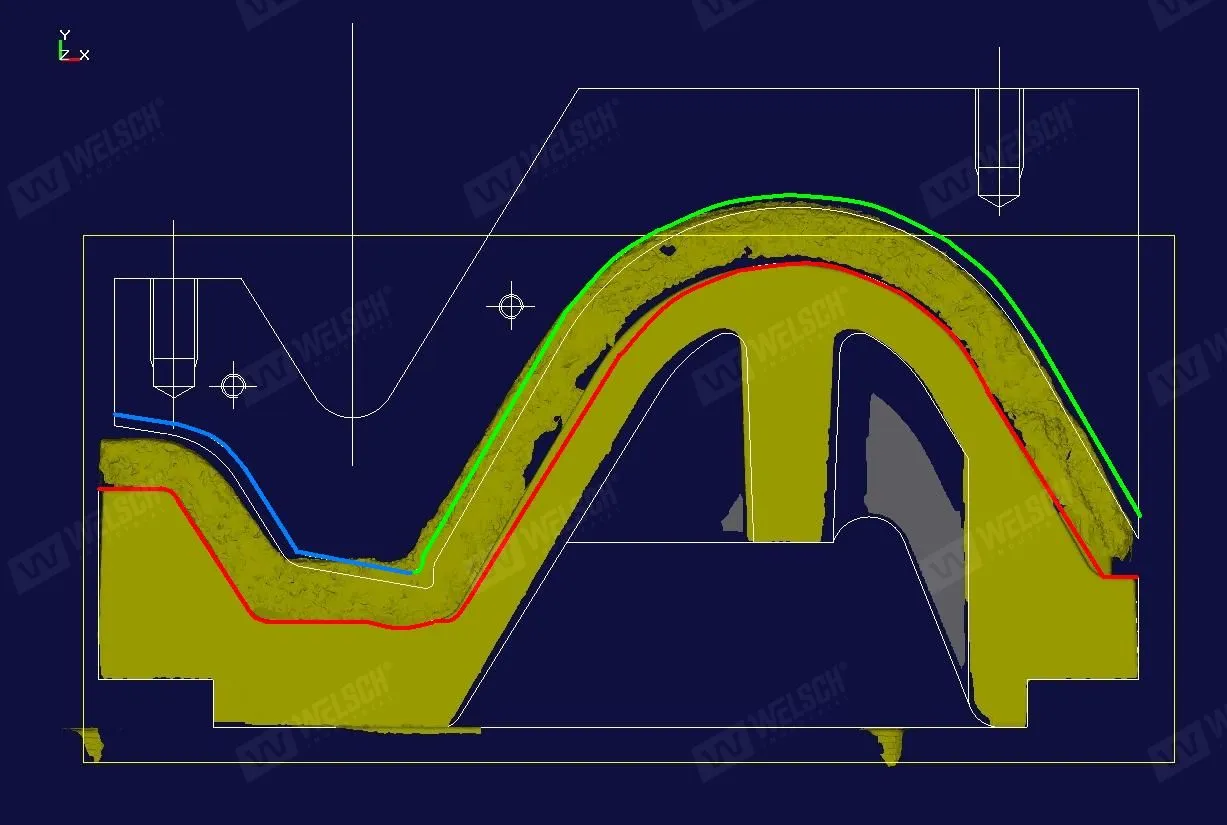
STL Generation for CAD/CAM: Once the design is finalized, we generate high-precision STL models and Cloud-of-Points data. This ensures a seamless transition to 5-axis CNC milling or 3D printing for rapid prototyping.
To achieve this level of hybrid complexity, we utilize a specialized software ecosystem: Rapidform (XO-S / XO-V / XO-R) as the industry standard for processing complex 3D scans into usable engineering surfaces. SolidWorks and Autodesk Inventor for the structural and kinematic integration of the freeform shapes into the broader machine assembly. Advanced Data Conversion to provide technical sovereignty by converting your organic designs into any native format (UniGraphics / SIEMENS NX, Pro/Engineer) or neutral format (STEP, IGES, SAT, VDA).
In the tile industry, the company that launches the most attractive profile first wins the market share. Accelerated R&D: By using our Hybrid Modeling and 3D visualization, you reduce the need for multiple physical prototyping cycles, cutting your time-to-market by up to 40%. Reduced Scrap Rates: We surgically design the freeform surfaces to minimize the risk of edge-break or surface-tears. Competitive Differentiation: You move away from being a commodity producer and become an architectural partner, allowing for higher margins and stronger brand positioning.
At WELSCH, we believe that "Art" and "Engineering" are not opposites. Through Hybrid Modeling, we ensure that your most innovative architectural ideas are backed by the calculated certainty of high-end mechanical simulation.
Technical Features
- Hybrid modeling: classic mechanical + 3D freeform surfaces
- Flow-dynamic optimization for 150 TPM compatibility
- Photorealistic 3D visualization and movement animation
- Rapidform, SolidWorks and Inventor software ecosystem
- STL generation for 5-axis CNC and 3D printing
- Universal data conversion to any native or neutral format
- Up to 40% faster time-to-market through digital prototyping
These products are customized solutions tailored precisely to your individual requirements. Contact us for personal consultation.
Frequently Asked Questions
Have Questions?
Our team of experts will be happy to advise you on this product.
At a Glance
- Custom manufacturing
- Made in Germany
- Worldwide shipping
- Technical support